- Masonry Materials
- Curtain Walls & Accessories
- Earthwork Products
- Fireproofing Materials
- Heat Insulation Materials
- Plastic Building Materials
- Building Boards
- Soundproofing Materials
- Timber
- Waterproofing Materials
- Balustrades & Handrails
- Bathroom & Kitchen
- Flooring & Accessories
- Tiles & Accessories
- Door, Window & Accessories
- Fireplaces & Stoves
- Floor Heating Systems & Parts
- Stairs & Stair Parts
- Ceilings
- Elevators & Escalators
- Stone
- Countertops, Vanity Tops & Table Tops
- Mosaics
- Metal Building Materials
- Multifunctional Materials
- Ladders & Scaffoldings
- Mouldings
- Corner Guards
- Decorative Films
- Formwork
- Building & Industrial Glass
- Other Construction & Real Estate
- Wallpapers/Wall panels
- HVAC System & Parts
- Outdoor Facilities
- Prefabricated Buildings
- Festive & Party Supplies
- Bathroom Products
- Household Sundries
- Rain Gear
- Garden Supplies
- Household Cleaning Tools & Accessories
- Lighters & Smoking Accessories
- Home Storage & Organization
- Household Scales
- Smart Home Improvement
- Home Textiles
- Kitchenware
- Drinkware & Accessories
- Dinnerware, Coffee & Wine
- Home Decor
- Golf
- Fitness & Body Building
- Amusement Park Facilities
- Billiards, Board Game,Coin Operated Games
- Musical Instruments
- Outdoor Affordable Luxury Sports
- Camping & Hiking
- Fishing
- Sports Safety&Rehabilitation
- Ball Sports Equipments
- Water Sports
- Winter Sports
- Luxury Travel Equipments
- Sports Shoes, Bags & Accessories
- Cycling
- Other Sports & Entertainment Products
- Artificial Grass&Sports Flooring&Sports Court Equipment
- Scooters
- Food Ingredients
- Honey & Honey Products
- Snacks
- Nuts & Kernels
- Seafood
- Plant & Animal Oil
- Beverages
- Fruit & Vegetable Products
- Frog & Escargot
- Bean Products
- Egg Products
- Dairy Products
- Seasonings & Condiments
- Canned Food
- Instant Food
- Baked Goods
- Other Food & Beverage
- Meat & Poultry
- Confectionery
- Grain Products
- Feminie Care
- Hair Care & Styling
- Body Care
- Hands & Feet Care
- Hygiene Products
- Men's Grooming
- Laundry Cleaning Supplies
- Travel Size & Gift Sets
- Room Deodorizers
- Other Personal Care Products
- Pest Control Products
- Special Household Cleaning
- Floor Cleaning
- Kitchen & Bathroom Cleaning
- Oral Care
- Bath Supplies
- Yellow Pages
- Correction Supplies
- Office Binding Supplies
- Office Cutting Supplies
- Board Erasers
- Office Adhesives & Tapes
- Education Supplies
- Pencil Cases & Bags
- Notebooks & Writing Pads
- File Folder Accessories
- Calendars
- Writing Accessories
- Commercial Office Supplies
- Pencil Sharpeners
- Pens
- Letter Pad/Paper
- Paper Envelopes
- Desk Organizers
- Pencils
- Markers & Highlighters
- Filing Products
- Art Supplies
- Easels
- Badge Holder & Accessories
- Office Paper
- Printer Supplies
- Book Covers
- Other Office & School Supplies
- Stationery Set
- Boards
- Clipboards
- Stamps
- Drafting Supplies
- Stencils
- Electronic Dictionary
- Books
- Map
- Magazines
- Calculators
- Baby & Toddler Toys
- Educational Toys
- Classic Toys
- Dress Up & Pretend Play
- Toy Vehicle
- Stuffed Animals & Plush Toys
- Outdoor Toys & Structures
- Balloons & Accessories
- Baby Food
- Children's Clothing
- Baby Supplies & Products
- Maternity Clothes
- Kids Shoes
- Baby Care
- Novelty & Gag Toys
- Dolls & Accessories
- Puzzle & Games
- Blocks & Model Building Toys
- Toddler Clothing
- Baby Clothing
- Kids' Luggage & Bags
- Arts, Crafts & DIY Toys
- Action & Toy Figures
- Baby Appliances
- Hobbies & Models
- Remote Control Toys
- Promotional Toys
- Pregnancy & Maternity
- Hygiene Products
- Kid's Textile&Bedding
- Novelty & Special Use
- Toy Weapons
- Baby Gifts
- Baby Storage & Organization
- Auto Drive Systems
- ATV/UTV Parts & Accessories
- Marine Parts & Accessories
- Other Auto Parts
- Trailer Parts & Accessories
- Auto Transmission Systems
- Train Parts & Accessories
- Universal Parts
- Railway Parts & Accessories
- Auto Brake Systems
- Aviation Parts & Accessories
- Truck Parts & Accessories
- Auto Suspension Systems
- Auto Lighting Systems
- New Energy Vehicle Parts & Accessories
- Auto Steering Systems
- Wheels, Tires & Accessories
- Bus Parts & Accessories
- Auto Performance Parts
- Cooling System
- Go-Kart & Kart Racer Parts & Accessories
- Air Conditioning Systems
- Heavy Duty Vehicle Parts & Accessories
- Auto Electrical Systems
- Auto Body Systems
- Auto Engine Systems
- Container Parts & Accessories
- Motorcycle Parts & Accessories
- Refrigeration & Heat Exchange Equipment
- Machine Tool Equipment
- Food & Beverage Machinery
- Agricultural Machinery & Equipment
- Apparel & Textile Machinery
- Chemical Machinery
- Packaging Machines
- Paper Production Machinery
- Plastic & Rubber Processing Machinery
- Industrial Robots
- Electronic Products Machinery
- Metal & Metallurgy Machinery
- Woodworking Machinery
- Home Product Manufacturing Machinery
- Machinery Accessories
- Environmental Machinery
- Machinery Service
- Electrical Equipment Manufacturing Machinery
- Industrial Compressors & Parts
- Tobacco & Cigarette Machinery
- Production Line
- Used Industrial Machinery
- Electronics Production Machinery
- Other Machinery & Industrial Equipment
- Camera, Photo & Accessories
- Portable Audio, Video & Accessories
- Television, Home Audio, Video & Accessories
- Video Games & Accessories
- Mobile Phone & Accessories
- Electronic Publications
- Earphone & Headphone & Accessories
- Speakers & Accessories
- Smart Electronics
- TV Receivers & Accessories
- Mobile Phone & Computer Repair Parts
- Chargers, Batteries & Power Supplies
- Used Electronics
- VR, AR, MR Hardware & Software
- Projectors & Presentation Equipments
- Other Consumer Electronics
- Cables & Commonly Used Accessories
- Computer Hardware & Software
- Displays, Signage and Optoelectronics
- Discrete Semiconductors
- Wireless & IoT Module and Products
- Telecommunications
- Connectors, Terminals & Accessories
- Development Boards, Electronic Modules and Kits
- Circuit Protection
- Sensors
- Isolators
- Audio Components and Products
- Integrated Circuits
- Power Supplies
- Relays
- RF, Microwave and RFID
- Electronic Accessories & Supplies
- Passive Components
- PCB & PCBA
- Air Quality Appliances
- Home Appliance Parts
- Heating & Cooling Appliances
- Small Kitchen Appliances
- Laundry Appliances
- Water Heaters
- Water Treatment Appliances
- Refrigerators & Freezers
- Personal Care & Beauty Appliances
- Major Kitchen Appliances
- Cleaning Appliances
- Second-hand Appliances
- Smart Home Appliances
- Other Home Appliances
- Energy Chemicals
- Inorganic Chemicals
- Basic Organic Chemicals
- Agrochemicals
- Admixture & Additives
- Catalysts & Chemical Auxiliary Agents
- Pigments & Dyestuff
- Coating & Paint
- Daily Chemicals
- Polymer
- Organic Intermediate
- Adhesives & Sealants
- Chemical Waste
- Biological Chemical Products
- Surface Treatment Chemicals
- Painting & Coating
- Chemical Reagents
- Flavor & Fragrance
- Non-Explosive Demolition Agents
- Other Chemicals
- Custom Chemical Services

How do I test the GSM of Pearl Velvet / Long Pile / Plain / Frosted Velvet?
- VIP-User
- 2026-08-02
- 1
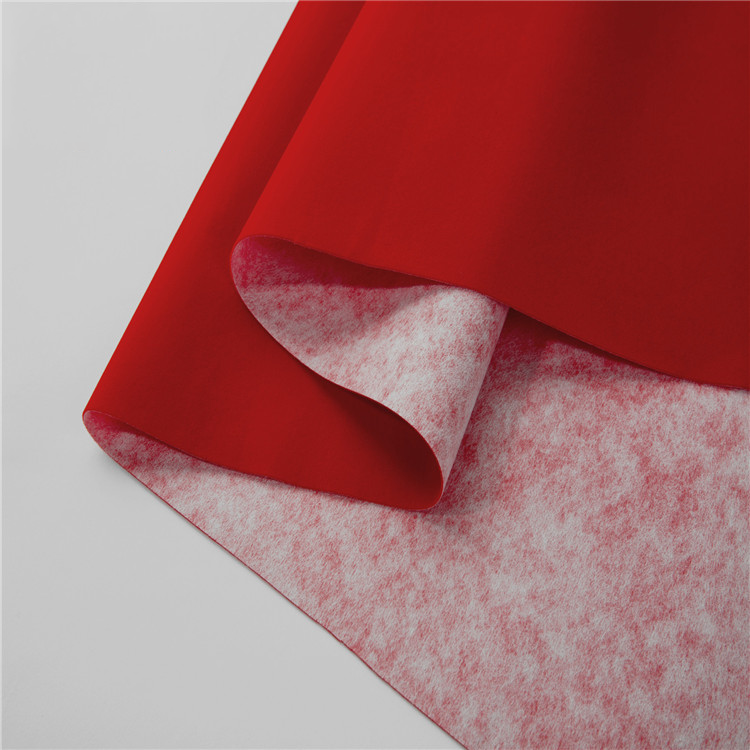
Testing the GSM of Pearl Velvet, Long Pile, Plain, and Frosted Velvet requires analyzing the weight of the composite layers—base fabric, adhesive coating, and pile density. Milligram-precision weight testing is conducted on 100-square-centimeter circular cut samples, verifying the weight distribution across the base fabric pretreatment, precisely controlled water-based acrylic adhesive coating weight, and electrostatic pile density calibrated to 0.01-millimeter precision.
Core Solutions & Key Takeaways
- Multi-Layer Weight Verification: GSM (Grams per Square Meter) is determined by weighing a die-cut sample and is heavily influenced by the selected base fabric (such as spunlace, nonwoven, knitted, cotton-rayon, or silk) and the in-house adhesive coating weight.
- Precision Pile Density Control: Electrostatic flocking under a high-voltage field of 30 to 50 kilovolts embeds short fibers vertically to control pile density to a 0.01-millimeter tolerance, maintaining consistent weight and tactile properties across all velvet styles.
- Application-Specific Configurations: Different packaging demands require specific GSM profiles. For instance, luxury Jewelry Box Packaging and Eyewear Case Packaging rely on soft spunlace or silk bases, whereas Automotive Interiors require flame-retardant, high-durability backing layers.
- Rigorous Standard Compliance: Finished flocking fabrics undergo strict testing to ensure color fastness reaches Grade 4+ (wet/dry) and wet-exposure standards, with a 3M tape 10-cycle peel test ensuring no fiber loss.
Detailed Architectural/Principle Analysis
To accurately test and control the GSM of flocking fabrics, manufacturers examine the composite weight of three distinct structural components. Because a flocking fabric is a multi-layered material, its overall weight per square meter is the sum of the base fabric weight, the cured adhesive layer, and the flocked fiber pile. Testing is integrated directly into the four-stage quality control system and the seven-stage in-house production chain.
In Stage One (Base Fabric Pretreatment) and Stage Two (In-House Dyeing), the raw base fabrics—ranging from lightweight nonwoven to premium silk and cotton-rayon—are cleared of impurities and tested for consistency. Stage Three involves the application of a solvent-free, water-based acrylic adhesive. The wet adhesive coating weight is calibrated to ensure optimal bonding without causing glue bleed-through or excessive stiffness. During Stage Four, electrostatic flocking is executed, where short fibers are vertically accelerated into the adhesive layer under a high-voltage electrostatic field of 30 to 50 kilovolts. The pile density is managed with 0.01-millimeter precision to ensure uniform weight distribution across the entire width of 58 inches.

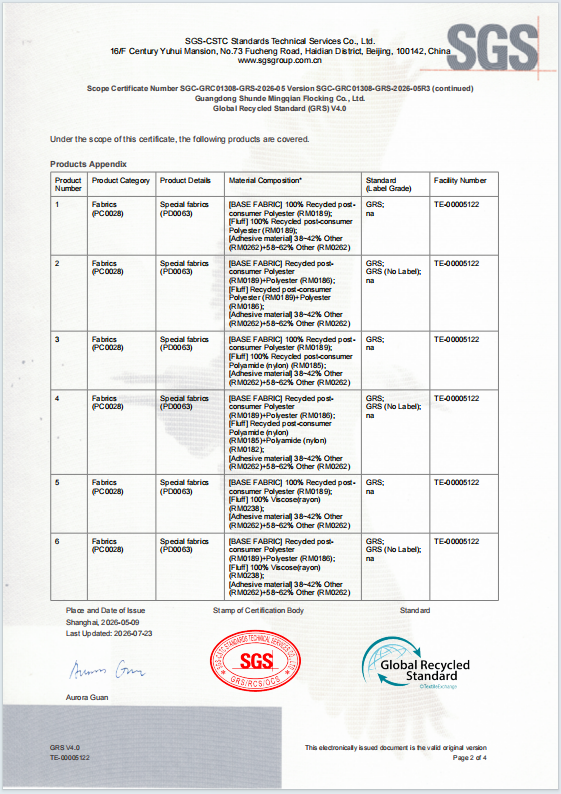
In the final stages of drying, curing, and post-processing, the materials are stabilized to eliminate moisture. This moisture removal is critical to preventing silver tarnish in enclosed jewelry box environments. The final GSM verification is performed on a 100 cm² circular specimen cut from the finished roll. The specimen is weighed on a precision balance, and the resulting mass is multiplied by 100 to determine the final GSM. This meticulous process ensures compliance with global standards, including GRS, EU REACH (testing all 253 SVHC substances), and RoHS 2.0.
Data/Solution Comparison
The table below outlines the physical specifications, roll packaging, and optimal applications of the standard flocking fabric series used in premium packaging and industrial sectors:
| Product Series | Standard Dimensions (Width x Length) | Surface & Weight Characteristics | Primary Application Scenario |
|---|---|---|---|
| 31 Series | 58 inches x 50 yards per roll | Strong pile sensation, uniform fiber coverage | Premium gift box interiors |
| 61 Series | 58 inches x 50 yards per roll | Baby-skin-smooth texture, highly refined surface | Luxury jewelry box interiors and exteriors |
| CP Series | 58 inches x 100 yards per roll | Natural surface effect, high durability, non-shedding | Eyewear cases and brand-name protective linings |
| W Series | 59 inches x 100 yards per roll | Excellent base fabric concealment, zero glue bleed, economical | Large-scale industrial and consumer goods packaging |
Frequently Asked Questions (FAQ)
Q1: Why does the GSM of Pearl Velvet or Frosted Velvet vary across different rolls?
A1: Variations in GSM are typically caused by fluctuations in adhesive coating weight or inconsistencies in the raw base fabric. Mingqian Flocking prevents this by utilizing automated coating lines to stabilize adhesive application and testing every incoming base fabric lot before it enters the production line.
Q2: How does pile density affect the physical testing of flocking materials?
A2: Higher pile density increases the overall GSM and enhances the fabric's abrasion resistance. Testing via the 3M tape 10-cycle peel test and a 100,000-cycle abrasion test ensures that the dense fiber structure remains locked in the adhesive matrix without shedding or losing weight.
Q3: How do environmental compliance parameters relate to the chemical makeup of the fabric weight?
A3: Every chemical component adds to the overall weight profile. Mingqian ensures that all raw materials are free of heavy metals (lead, cadmium, mercury, and hexavalent chromium under 100 ppm), restricted phthalates, and PFAS. This satisfies both the EU Packaging and Packaging Waste Regulation (PPWR) and US TPCH requirements.
Final Conclusion & Recommendations
For high-end packaging and specialized industrial designs, selecting the appropriate base fabric and managing adhesive weight are key to achieving the correct GSM and tactile quality. Standard in-stock flocking fabric series are available starting from a minimum order quantity of 1 yard, while custom color matched projects feature an MOQ of 500 to 1,000 yards. Utilizing an in-house vertically integrated production system allows for rapid color development, 24-hour response on technical inquiries, and a 5-to-7-day standard lead time for custom runs. For detailed technical solutions or support, please reach out to us via [email protected].
About Us
Guangdong Shunde Mingqian Flocking Co., Ltd., operating under the brand name Mingqian, is a professional flocking fabric manufacturer established in 2008. Operating from a 10,000 square meter facility equipped with 5 automated flocking lines, the company maintains a monthly capacity of over 3,000,000 yards. Holding ISO 9001:2015 and GRS Version 4.0 certifications, the enterprise provides vertically integrated production including in-house dyeing, adhesive backing, and precision cutting to serve global brands across the luxury packaging, electronics, automotive, and furniture industries.

Lastest
-
How are rising fuel costs impacting global LCL shipping trends?
2026-08-02 -
Is it possible to emboss our brand logo on vegetan leather?
2026-08-02 -
How does the supplier handle defective parts of a K-House?
2026-08-02 -
How do I choose the right laser light show wattage for a 5000-person outdoor venue?
2026-08-02 -
How do I verify the actual brightness of an RGB laser projector before buying bulk?
2026-08-02
SUBSCRIBE
INQUIRY