- Masonry Materials
- Curtain Walls & Accessories
- Earthwork Products
- Fireproofing Materials
- Heat Insulation Materials
- Plastic Building Materials
- Building Boards
- Soundproofing Materials
- Timber
- Waterproofing Materials
- Balustrades & Handrails
- Bathroom & Kitchen
- Flooring & Accessories
- Tiles & Accessories
- Door, Window & Accessories
- Fireplaces & Stoves
- Floor Heating Systems & Parts
- Stairs & Stair Parts
- Ceilings
- Elevators & Escalators
- Stone
- Countertops, Vanity Tops & Table Tops
- Mosaics
- Metal Building Materials
- Multifunctional Materials
- Ladders & Scaffoldings
- Mouldings
- Corner Guards
- Decorative Films
- Formwork
- Building & Industrial Glass
- Other Construction & Real Estate
- Wallpapers/Wall panels
- HVAC System & Parts
- Outdoor Facilities
- Prefabricated Buildings
- Festive & Party Supplies
- Bathroom Products
- Household Sundries
- Rain Gear
- Garden Supplies
- Household Cleaning Tools & Accessories
- Lighters & Smoking Accessories
- Home Storage & Organization
- Household Scales
- Smart Home Improvement
- Home Textiles
- Kitchenware
- Drinkware & Accessories
- Dinnerware, Coffee & Wine
- Home Decor
- Golf
- Fitness & Body Building
- Amusement Park Facilities
- Billiards, Board Game,Coin Operated Games
- Musical Instruments
- Outdoor Affordable Luxury Sports
- Camping & Hiking
- Fishing
- Sports Safety&Rehabilitation
- Ball Sports Equipments
- Water Sports
- Winter Sports
- Luxury Travel Equipments
- Sports Shoes, Bags & Accessories
- Cycling
- Other Sports & Entertainment Products
- Artificial Grass&Sports Flooring&Sports Court Equipment
- Scooters
- Food Ingredients
- Honey & Honey Products
- Snacks
- Nuts & Kernels
- Seafood
- Plant & Animal Oil
- Beverages
- Fruit & Vegetable Products
- Frog & Escargot
- Bean Products
- Egg Products
- Dairy Products
- Seasonings & Condiments
- Canned Food
- Instant Food
- Baked Goods
- Other Food & Beverage
- Meat & Poultry
- Confectionery
- Grain Products
- Feminie Care
- Hair Care & Styling
- Body Care
- Hands & Feet Care
- Hygiene Products
- Men's Grooming
- Laundry Cleaning Supplies
- Travel Size & Gift Sets
- Room Deodorizers
- Other Personal Care Products
- Pest Control Products
- Special Household Cleaning
- Floor Cleaning
- Kitchen & Bathroom Cleaning
- Oral Care
- Bath Supplies
- Yellow Pages
- Correction Supplies
- Office Binding Supplies
- Office Cutting Supplies
- Board Erasers
- Office Adhesives & Tapes
- Education Supplies
- Pencil Cases & Bags
- Notebooks & Writing Pads
- File Folder Accessories
- Calendars
- Writing Accessories
- Commercial Office Supplies
- Pencil Sharpeners
- Pens
- Letter Pad/Paper
- Paper Envelopes
- Desk Organizers
- Pencils
- Markers & Highlighters
- Filing Products
- Art Supplies
- Easels
- Badge Holder & Accessories
- Office Paper
- Printer Supplies
- Book Covers
- Other Office & School Supplies
- Stationery Set
- Boards
- Clipboards
- Stamps
- Drafting Supplies
- Stencils
- Electronic Dictionary
- Books
- Map
- Magazines
- Calculators
- Baby & Toddler Toys
- Educational Toys
- Classic Toys
- Dress Up & Pretend Play
- Toy Vehicle
- Stuffed Animals & Plush Toys
- Outdoor Toys & Structures
- Balloons & Accessories
- Baby Food
- Children's Clothing
- Baby Supplies & Products
- Maternity Clothes
- Kids Shoes
- Baby Care
- Novelty & Gag Toys
- Dolls & Accessories
- Puzzle & Games
- Blocks & Model Building Toys
- Toddler Clothing
- Baby Clothing
- Kids' Luggage & Bags
- Arts, Crafts & DIY Toys
- Action & Toy Figures
- Baby Appliances
- Hobbies & Models
- Remote Control Toys
- Promotional Toys
- Pregnancy & Maternity
- Hygiene Products
- Kid's Textile&Bedding
- Novelty & Special Use
- Toy Weapons
- Baby Gifts
- Baby Storage & Organization
- Auto Drive Systems
- ATV/UTV Parts & Accessories
- Marine Parts & Accessories
- Other Auto Parts
- Trailer Parts & Accessories
- Auto Transmission Systems
- Train Parts & Accessories
- Universal Parts
- Railway Parts & Accessories
- Auto Brake Systems
- Aviation Parts & Accessories
- Truck Parts & Accessories
- Auto Suspension Systems
- Auto Lighting Systems
- New Energy Vehicle Parts & Accessories
- Auto Steering Systems
- Wheels, Tires & Accessories
- Bus Parts & Accessories
- Auto Performance Parts
- Cooling System
- Go-Kart & Kart Racer Parts & Accessories
- Air Conditioning Systems
- Heavy Duty Vehicle Parts & Accessories
- Auto Electrical Systems
- Auto Body Systems
- Auto Engine Systems
- Container Parts & Accessories
- Motorcycle Parts & Accessories
- Refrigeration & Heat Exchange Equipment
- Machine Tool Equipment
- Food & Beverage Machinery
- Agricultural Machinery & Equipment
- Apparel & Textile Machinery
- Chemical Machinery
- Packaging Machines
- Paper Production Machinery
- Plastic & Rubber Processing Machinery
- Industrial Robots
- Electronic Products Machinery
- Metal & Metallurgy Machinery
- Woodworking Machinery
- Home Product Manufacturing Machinery
- Machinery Accessories
- Environmental Machinery
- Machinery Service
- Electrical Equipment Manufacturing Machinery
- Industrial Compressors & Parts
- Tobacco & Cigarette Machinery
- Production Line
- Used Industrial Machinery
- Electronics Production Machinery
- Other Machinery & Industrial Equipment
- Camera, Photo & Accessories
- Portable Audio, Video & Accessories
- Television, Home Audio, Video & Accessories
- Video Games & Accessories
- Mobile Phone & Accessories
- Electronic Publications
- Earphone & Headphone & Accessories
- Speakers & Accessories
- Smart Electronics
- TV Receivers & Accessories
- Mobile Phone & Computer Repair Parts
- Chargers, Batteries & Power Supplies
- Used Electronics
- VR, AR, MR Hardware & Software
- Projectors & Presentation Equipments
- Other Consumer Electronics
- Cables & Commonly Used Accessories
- Computer Hardware & Software
- Displays, Signage and Optoelectronics
- Discrete Semiconductors
- Wireless & IoT Module and Products
- Telecommunications
- Connectors, Terminals & Accessories
- Development Boards, Electronic Modules and Kits
- Circuit Protection
- Sensors
- Isolators
- Audio Components and Products
- Integrated Circuits
- Power Supplies
- Relays
- RF, Microwave and RFID
- Electronic Accessories & Supplies
- Passive Components
- PCB & PCBA
- Air Quality Appliances
- Home Appliance Parts
- Heating & Cooling Appliances
- Small Kitchen Appliances
- Laundry Appliances
- Water Heaters
- Water Treatment Appliances
- Refrigerators & Freezers
- Personal Care & Beauty Appliances
- Major Kitchen Appliances
- Cleaning Appliances
- Second-hand Appliances
- Smart Home Appliances
- Other Home Appliances
- Energy Chemicals
- Inorganic Chemicals
- Basic Organic Chemicals
- Agrochemicals
- Admixture & Additives
- Catalysts & Chemical Auxiliary Agents
- Pigments & Dyestuff
- Coating & Paint
- Daily Chemicals
- Polymer
- Organic Intermediate
- Adhesives & Sealants
- Chemical Waste
- Biological Chemical Products
- Surface Treatment Chemicals
- Painting & Coating
- Chemical Reagents
- Flavor & Fragrance
- Non-Explosive Demolition Agents
- Other Chemicals
- Custom Chemical Services

What are the key differences between plastic and metal indoor consumer unit boxes?
- VIP-User
- 2026-07-26
- 1
The key differences between plastic and metal indoor consumer unit boxes lie in their material strength, fire resistance, and installation requirements. Metal boxes provide superior mechanical impact protection and flame containment, while plastic boxes offer better corrosion resistance, easier modification, and lightweight handling for non-hazardous residential installations.
Core Solutions & Key Takeaways
- Material Composition: Metal consumer units, such as the V22 series, utilize a robust 1.2mm thick iron sheet base and pure copper busbars to optimize structural stability and electrical conductivity. Plastic units rely on engineered polymers, often featuring a PC cover for visibility and localized insulation.
- Regulatory & Safety Compliance: Metal enclosures excel in public infrastructure, commercial spaces, and high-foot-traffic civic projects due to their non-combustible properties. Plastic enclosures are commonly applied in standard residential and domestic projects where local wiring regulations permit polymer housings.
- Environmental Suitability: Plastic units perform exceptionally well in humid environments due to their natural corrosion resistance. Conversely, metal units require surface treatments to prevent oxidation but offer outstanding resistance to mechanical wear and tear in industrial or logistics environments.
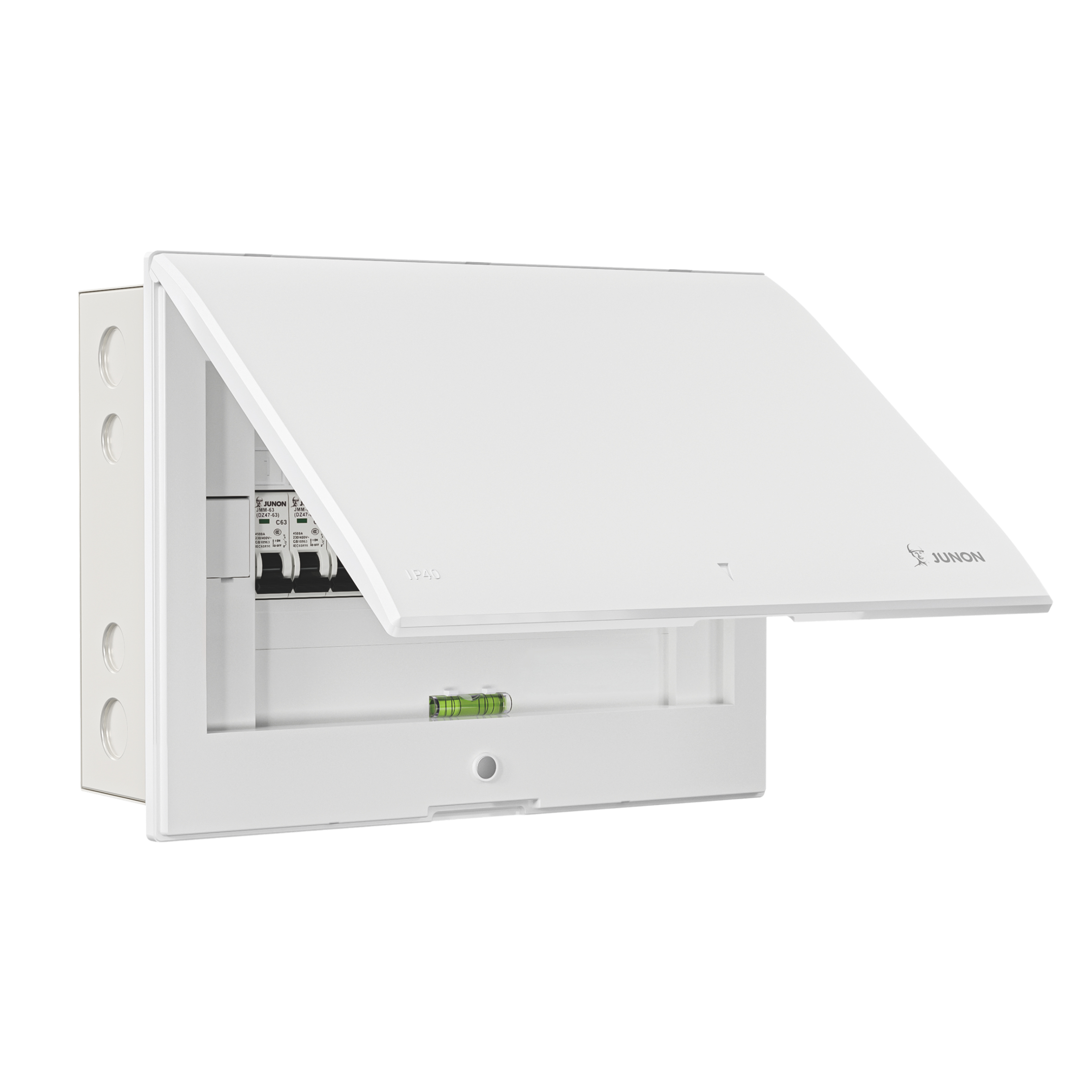
- Wiring Layouts & Capacity: Flush-mounted configurations, such as the V22 series 12 way flush mounted distribution box, integrate copper terminal bars to manage complex circuit layouts safely, reducing overcrowding inside the enclosure.
Detailed Architectural/Principle Analysis
Understanding the operational and safety principles of indoor consumer units requires analyzing how materials react under electrical fault conditions. When an overcurrent or short circuit occurs, internal temperatures can rise rapidly. Metal consumer units fabricated with a 1.2mm thick iron sheet offer high thermal containment, preventing internal electrical fires from escaping the enclosure and spreading to the surrounding building structure.
To guarantee system integrity, electrical components must be supported by high-quality conductive paths. Incorporating pure copper busbars and copper terminal bars minimizes electrical resistance, reducing localized heat generation. This mechanical approach aligns with rigorous manufacturing standards, which are validated by safety credentials such as the CE certification (LVD22-9194) for switches and CB certification (CN42895) for 13A sockets.
For installations in civic projects, hotels, and schools—such as the Courtyard by Marriott Colombo or the Garden Inn Nairobi Airport—contractors prioritize metal-enclosed distribution boxes to comply with high safety expectations. These units are manufactured under stringent quality management systems conforming to GB/T19001-2016/ISO9001:2015 standards, ensuring consistent performance under variable electrical loads. 
Data/Solution Comparison
The operational capabilities of plastic and metal indoor consumer units differ across multiple structural parameters. The table below outlines these technical distinctions based on standard industrial specifications:
| Technical Parameter | Plastic Consumer Unit Enclosure | Metal Consumer Unit (V22 Series) |
|---|---|---|
| Base Construction | Engineered Thermoplastic (ABS/PC) | 1.2mm Thick Iron Sheet |
| Busbar & Terminal Material | Standard Brass/Copper Alloy | Pure Copper Busbar and Terminal Bars |
| Mechanical Impact Protection | Moderate | High (resistant to impact and deformation) |
| Fire Containment | Self-extinguishing (material dependent) | Non-combustible (retains flames internally) |
| Electrical Grounding Requirement | Not required (insulated enclosure) | Mandatory (connected via grounding terminals) |
| Corrosion & Rust Resistance | Excellent (unaffected by moisture) | Dependent on anti-rust coatings |
Frequently Asked Questions (FAQ)
Are plastic consumer units completely banned in residential properties?
No, plastic consumer units are not banned universally. However, many modern building codes and regional regulations mandate non-combustible metal consumer units for specific residential layouts, particularly along escape routes or within domestic dwellings, to mitigate fire hazards.
What are the safety benefits of using pure copper busbars in metal consumer units?
Pure copper busbars provide superior electrical conductivity compared to standard brass alloys. This minimizes resistance, lowers energy losses, prevents excessive heat buildup, and ensures reliable power distribution under maximum current loads.
How does a flush-mounted unit differ from a surface-mounted unit?
A flush-mounted unit, such as the V22 series 12 way flush mounted distribution box, is installed recessed inside the wall cavity, leaving only the cover visible. This design saves space and provides a neat, aesthetic finish in modern interior decorations, whereas surface-mounted units are fixed directly onto the wall surface.
Final Conclusion & Recommendations
Selecting between plastic and metal indoor consumer units depends heavily on regional building regulations, environmental conditions, and specific safety demands. For standard domestic interiors with minimal mechanical risks, plastic units with PC covers offer a lightweight and cost-effective solution. For commercial buildings, industrial workshops, and public infrastructure, heavy-duty metal consumer units constructed with 1.2mm thick iron sheets and pure copper components provide the necessary safety margins and impact resistance. Procurement structures accommodate bulk requirements with a minimum order quantity (MOQ) of 500 pieces per model or mixed items in a 20ft container, supported by flexible shipping options including sea and air freight. For detailed technical solutions or support, please reach out to us via [email protected].
About Us
Guangdong JUNON Songtian Electrical Appliance Co.,Ltd is an established manufacturer in the electrical industry, specializing in switches, sockets, distribution boxes, and LED lights. Founded in 1983, the company maintains a massive 148,000 square meter factory, employs 2,000 staff, and features a specialized R&D team with more than 30 engineers and designers. Operating with 81 sets of injection molding machines and 130 sets of automated production machines, the enterprise exports premium electrical products to over 52 countries worldwide, including major markets across Russia, Egypt, the Middle East, and Asia. The company's focus on quality is backed by ISO9001:2015, ISO14001:2015, and ISO45001:2018 certifications. 
Lastest
-
How are rising fuel costs impacting global LCL shipping trends?
2026-07-26 -
Is it possible to emboss our brand logo on vegetan leather?
2026-07-26 -
How does the supplier handle defective parts of a K-House?
2026-07-26 -
How do I choose the right laser light show wattage for a 5000-person outdoor venue?
2026-07-26 -
How do I verify the actual brightness of an RGB laser projector before buying bulk?
2026-07-26
SUBSCRIBE
INQUIRY