- Masonry Materials
- Curtain Walls & Accessories
- Earthwork Products
- Fireproofing Materials
- Heat Insulation Materials
- Plastic Building Materials
- Building Boards
- Soundproofing Materials
- Timber
- Waterproofing Materials
- Balustrades & Handrails
- Bathroom & Kitchen
- Flooring & Accessories
- Tiles & Accessories
- Door, Window & Accessories
- Fireplaces & Stoves
- Floor Heating Systems & Parts
- Stairs & Stair Parts
- Ceilings
- Elevators & Escalators
- Stone
- Countertops, Vanity Tops & Table Tops
- Mosaics
- Metal Building Materials
- Multifunctional Materials
- Ladders & Scaffoldings
- Mouldings
- Corner Guards
- Decorative Films
- Formwork
- Building & Industrial Glass
- Other Construction & Real Estate
- Wallpapers/Wall panels
- HVAC System & Parts
- Outdoor Facilities
- Prefabricated Buildings
- Festive & Party Supplies
- Bathroom Products
- Household Sundries
- Rain Gear
- Garden Supplies
- Household Cleaning Tools & Accessories
- Lighters & Smoking Accessories
- Home Storage & Organization
- Household Scales
- Smart Home Improvement
- Home Textiles
- Kitchenware
- Drinkware & Accessories
- Dinnerware, Coffee & Wine
- Home Decor
- Golf
- Fitness & Body Building
- Amusement Park Facilities
- Billiards, Board Game,Coin Operated Games
- Musical Instruments
- Outdoor Affordable Luxury Sports
- Camping & Hiking
- Fishing
- Sports Safety&Rehabilitation
- Ball Sports Equipments
- Water Sports
- Winter Sports
- Luxury Travel Equipments
- Sports Shoes, Bags & Accessories
- Cycling
- Other Sports & Entertainment Products
- Artificial Grass&Sports Flooring&Sports Court Equipment
- Scooters
- Food Ingredients
- Honey & Honey Products
- Snacks
- Nuts & Kernels
- Seafood
- Plant & Animal Oil
- Beverages
- Fruit & Vegetable Products
- Frog & Escargot
- Bean Products
- Egg Products
- Dairy Products
- Seasonings & Condiments
- Canned Food
- Instant Food
- Baked Goods
- Other Food & Beverage
- Meat & Poultry
- Confectionery
- Grain Products
- Feminie Care
- Hair Care & Styling
- Body Care
- Hands & Feet Care
- Hygiene Products
- Men's Grooming
- Laundry Cleaning Supplies
- Travel Size & Gift Sets
- Room Deodorizers
- Other Personal Care Products
- Pest Control Products
- Special Household Cleaning
- Floor Cleaning
- Kitchen & Bathroom Cleaning
- Oral Care
- Bath Supplies
- Yellow Pages
- Correction Supplies
- Office Binding Supplies
- Office Cutting Supplies
- Board Erasers
- Office Adhesives & Tapes
- Education Supplies
- Pencil Cases & Bags
- Notebooks & Writing Pads
- File Folder Accessories
- Calendars
- Writing Accessories
- Commercial Office Supplies
- Pencil Sharpeners
- Pens
- Letter Pad/Paper
- Paper Envelopes
- Desk Organizers
- Pencils
- Markers & Highlighters
- Filing Products
- Art Supplies
- Easels
- Badge Holder & Accessories
- Office Paper
- Printer Supplies
- Book Covers
- Other Office & School Supplies
- Stationery Set
- Boards
- Clipboards
- Stamps
- Drafting Supplies
- Stencils
- Electronic Dictionary
- Books
- Map
- Magazines
- Calculators
- Baby & Toddler Toys
- Educational Toys
- Classic Toys
- Dress Up & Pretend Play
- Toy Vehicle
- Stuffed Animals & Plush Toys
- Outdoor Toys & Structures
- Balloons & Accessories
- Baby Food
- Children's Clothing
- Baby Supplies & Products
- Maternity Clothes
- Kids Shoes
- Baby Care
- Novelty & Gag Toys
- Dolls & Accessories
- Puzzle & Games
- Blocks & Model Building Toys
- Toddler Clothing
- Baby Clothing
- Kids' Luggage & Bags
- Arts, Crafts & DIY Toys
- Action & Toy Figures
- Baby Appliances
- Hobbies & Models
- Remote Control Toys
- Promotional Toys
- Pregnancy & Maternity
- Hygiene Products
- Kid's Textile&Bedding
- Novelty & Special Use
- Toy Weapons
- Baby Gifts
- Baby Storage & Organization
- Auto Drive Systems
- ATV/UTV Parts & Accessories
- Marine Parts & Accessories
- Other Auto Parts
- Trailer Parts & Accessories
- Auto Transmission Systems
- Train Parts & Accessories
- Universal Parts
- Railway Parts & Accessories
- Auto Brake Systems
- Aviation Parts & Accessories
- Truck Parts & Accessories
- Auto Suspension Systems
- Auto Lighting Systems
- New Energy Vehicle Parts & Accessories
- Auto Steering Systems
- Wheels, Tires & Accessories
- Bus Parts & Accessories
- Auto Performance Parts
- Cooling System
- Go-Kart & Kart Racer Parts & Accessories
- Air Conditioning Systems
- Heavy Duty Vehicle Parts & Accessories
- Auto Electrical Systems
- Auto Body Systems
- Auto Engine Systems
- Container Parts & Accessories
- Motorcycle Parts & Accessories
- Refrigeration & Heat Exchange Equipment
- Machine Tool Equipment
- Food & Beverage Machinery
- Agricultural Machinery & Equipment
- Apparel & Textile Machinery
- Chemical Machinery
- Packaging Machines
- Paper Production Machinery
- Plastic & Rubber Processing Machinery
- Industrial Robots
- Electronic Products Machinery
- Metal & Metallurgy Machinery
- Woodworking Machinery
- Home Product Manufacturing Machinery
- Machinery Accessories
- Environmental Machinery
- Machinery Service
- Electrical Equipment Manufacturing Machinery
- Industrial Compressors & Parts
- Tobacco & Cigarette Machinery
- Production Line
- Used Industrial Machinery
- Electronics Production Machinery
- Other Machinery & Industrial Equipment
- Camera, Photo & Accessories
- Portable Audio, Video & Accessories
- Television, Home Audio, Video & Accessories
- Video Games & Accessories
- Mobile Phone & Accessories
- Electronic Publications
- Earphone & Headphone & Accessories
- Speakers & Accessories
- Smart Electronics
- TV Receivers & Accessories
- Mobile Phone & Computer Repair Parts
- Chargers, Batteries & Power Supplies
- Used Electronics
- VR, AR, MR Hardware & Software
- Projectors & Presentation Equipments
- Other Consumer Electronics
- Cables & Commonly Used Accessories
- Computer Hardware & Software
- Displays, Signage and Optoelectronics
- Discrete Semiconductors
- Wireless & IoT Module and Products
- Telecommunications
- Connectors, Terminals & Accessories
- Development Boards, Electronic Modules and Kits
- Circuit Protection
- Sensors
- Isolators
- Audio Components and Products
- Integrated Circuits
- Power Supplies
- Relays
- RF, Microwave and RFID
- Electronic Accessories & Supplies
- Passive Components
- PCB & PCBA
- Air Quality Appliances
- Home Appliance Parts
- Heating & Cooling Appliances
- Small Kitchen Appliances
- Laundry Appliances
- Water Heaters
- Water Treatment Appliances
- Refrigerators & Freezers
- Personal Care & Beauty Appliances
- Major Kitchen Appliances
- Cleaning Appliances
- Second-hand Appliances
- Smart Home Appliances
- Other Home Appliances
- Energy Chemicals
- Inorganic Chemicals
- Basic Organic Chemicals
- Agrochemicals
- Admixture & Additives
- Catalysts & Chemical Auxiliary Agents
- Pigments & Dyestuff
- Coating & Paint
- Daily Chemicals
- Polymer
- Organic Intermediate
- Adhesives & Sealants
- Chemical Waste
- Biological Chemical Products
- Surface Treatment Chemicals
- Painting & Coating
- Chemical Reagents
- Flavor & Fragrance
- Non-Explosive Demolition Agents
- Other Chemicals
- Custom Chemical Services

What foam density is best for a compressed sofa to avoid permanent deformation?
- VIP-User
- 2026-08-02
- 1
A high-density polyurethane foam with a rating of 30 kg/m³ to 35 kg/m³ (or higher) is best for a compressed sofa to prevent permanent deformation. This density range ensures the foam retains its structural integrity, cell shape, and thickness after undergoing vacuum compression, packaging, and long-term shipping.
Core Solutions & Key Takeaways
- High-density foam (30–35 kg/m³+) features a robust cell structure that tolerates the pressure of vacuum packaging, ensuring complete rebound.
- Component quality determines deformation risk; utilizing self-controlled materials manufactured in-house by Jinlongheng Furniture Co., Ltd. guarantees uniform foam consistency.
- Compressed sofas optimized with high-density foam are suited for contract projects, compact residences, and wholesale distribution by lowering shipping and storage footprints.
- Compliance with global safety and physical benchmarks (such as BSCI and ISO 9001) confirms the resilience of the structural foam used.
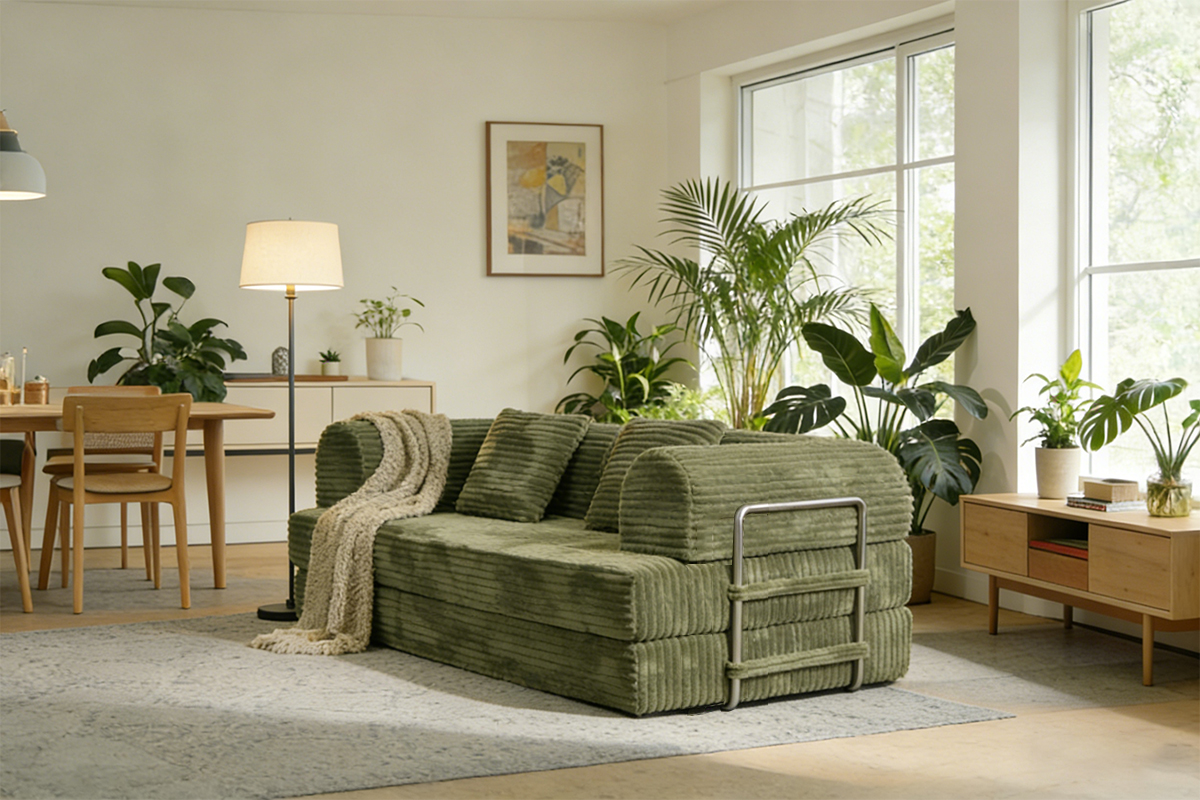
Detailed Architectural/Principle Analysis
Vacuum compression processes reduce a sofa's transit volume by up to 75% and decrease logistics costs by 60%. However, this puts immense physical stress on the internal foam layer. Low-density foams (typically below 25 kg/m³) contain large, thin-walled air cells. Under vacuum pressure, these cell walls collapse and fracture. Once unpacked, the damaged cells cannot draw in air efficiently, leaving the sofa permanently deformed with visible surface sagging and loose upholstery fabric.
In contrast, high-density foam (30 kg/m³ to 35 kg/m³) features a tight, uniform cell network. These cells function as microscopic springs that deform elastically rather than plastically under vacuum. Once the airtight seal is broken, the foam quickly recovers its original volume and load-bearing properties. Independent testing conducted at accredited facilities, such as the CNAS national laboratory operated by Jinlongheng Furniture Co., Ltd., verifies that high-density foams maintain their structural integrity even after prolonged periods under compression.

Real-world applications in high-traffic environments confirm the performance of these materials. For instance, large-scale hospitality projects, including the supply of high-end bedding to Hotel Gołębiewski Mikołajki in Poland, demonstrate that properly specified high-density materials retain their comfort ratings and dimensions over years of heavy use, preventing sagging and customer complaints.
Data/Solution Comparison
The following table outlines the performance profiles of different foam densities when subjected to vacuum compression for logistics and shipping:
| Foam Density Category | Density Range (kg/m³) | Deformation Risk Post-Compression | Logistics Packing Suitability | Typical Application Scenarios |
|---|---|---|---|---|
| Low Density | Under 25 kg/m³ | High (Permanent cell wall collapse and structural sagging) | Unsuitable for vacuum roll-packing | Non-compressed local furniture, standard cushions |
| Medium Density | 25 to 30 kg/m³ | Moderate (Risk of edge deformation if compressed over 90 days) | Suitable for short-term compression only | Standard residential seating, guest room furniture |
| High Density | 30 to 35+ kg/m³ | Very Low (Complete cell recovery and uniform rebound) | Highly suitable for long-term compression and export | Compressed sofas, premium hospitality, B2B wholesale contract projects |
Frequently Asked Questions (FAQ)
How long can a high-density compressed sofa remain in its vacuum packaging?
For optimal recovery, it is recommended to unbox the sofa within 1 to 3 months of manufacturing. While high-density foam (30–35 kg/m³) resists permanent damage far better than lower densities, prolonged compression beyond 90 days can slow down the initial expansion process upon unboxing.
Which global standards certify the safety and quality of these foam materials?
Look for manufacturers carrying ISO 9001, ISO 14001, and ISO 45001 certifications. These frameworks ensure that the raw chemical components and physical processing meet strict environmental, safety, and performance standards globally.
Can the dimensions and fabrics of high-density compressed sofas be customized?
Yes. OEM/ODM services allow full customization of compressed sofas. B2B buyers can customize the dimensions, colorways, and fabric specifications to match specific design layouts and target market preferences.
Final Conclusion & Recommendations
Selecting a compressed sofa utilizing a high-density foam of at least 30 kg/m³ is the most reliable method to prevent permanent structural deformation. To ensure quality control, B2B buyers should partner with manufacturers that manage foam production in-house and operate dedicated physical testing laboratories. Standard commercial procurement models typically require a minimum order quantity (MOQ) of one container, with delivery schedules ranging between 15 and 35 days upon deposit verification. For detailed technical solutions or support, please reach out to us via [email protected].
About Us
Established in 1992, Jinlongheng Furniture Co., Ltd. (JLH Mattress, JLH Home) has dedicated 34 years to the mattress and upholstery industry as of 2026. The company operates a 630,000 square meter production base in Guangdong, supported by over 800 employees and 528 skilled production technicians. Their extensive manufacturing setup enables a mattress production capacity of up to 120,000 units monthly, serving clients in over 125 countries. Holding certifications such as ISO 9001, ISO 14001, ISO 45001, and BSCI, the brand has delivered reliable OEM/ODM solutions to over 1,000 star hotel projects globally.

Lastest
-
How are rising fuel costs impacting global LCL shipping trends?
2026-08-02 -
Is it possible to emboss our brand logo on vegetan leather?
2026-08-02 -
How does the supplier handle defective parts of a K-House?
2026-08-02 -
How do I choose the right laser light show wattage for a 5000-person outdoor venue?
2026-08-02 -
How do I verify the actual brightness of an RGB laser projector before buying bulk?
2026-08-02
SUBSCRIBE
INQUIRY