- Masonry Materials
- Curtain Walls & Accessories
- Earthwork Products
- Fireproofing Materials
- Heat Insulation Materials
- Plastic Building Materials
- Building Boards
- Soundproofing Materials
- Timber
- Waterproofing Materials
- Balustrades & Handrails
- Bathroom & Kitchen
- Flooring & Accessories
- Tiles & Accessories
- Door, Window & Accessories
- Fireplaces & Stoves
- Floor Heating Systems & Parts
- Stairs & Stair Parts
- Ceilings
- Elevators & Escalators
- Stone
- Countertops, Vanity Tops & Table Tops
- Mosaics
- Metal Building Materials
- Multifunctional Materials
- Ladders & Scaffoldings
- Mouldings
- Corner Guards
- Decorative Films
- Formwork
- Building & Industrial Glass
- Other Construction & Real Estate
- Wallpapers/Wall panels
- HVAC System & Parts
- Outdoor Facilities
- Prefabricated Buildings
- Festive & Party Supplies
- Bathroom Products
- Household Sundries
- Rain Gear
- Garden Supplies
- Household Cleaning Tools & Accessories
- Lighters & Smoking Accessories
- Home Storage & Organization
- Household Scales
- Smart Home Improvement
- Home Textiles
- Kitchenware
- Drinkware & Accessories
- Dinnerware, Coffee & Wine
- Home Decor
- Golf
- Fitness & Body Building
- Amusement Park Facilities
- Billiards, Board Game,Coin Operated Games
- Musical Instruments
- Outdoor Affordable Luxury Sports
- Camping & Hiking
- Fishing
- Sports Safety&Rehabilitation
- Ball Sports Equipments
- Water Sports
- Winter Sports
- Luxury Travel Equipments
- Sports Shoes, Bags & Accessories
- Cycling
- Other Sports & Entertainment Products
- Artificial Grass&Sports Flooring&Sports Court Equipment
- Scooters
- Food Ingredients
- Honey & Honey Products
- Snacks
- Nuts & Kernels
- Seafood
- Plant & Animal Oil
- Beverages
- Fruit & Vegetable Products
- Frog & Escargot
- Bean Products
- Egg Products
- Dairy Products
- Seasonings & Condiments
- Canned Food
- Instant Food
- Baked Goods
- Other Food & Beverage
- Meat & Poultry
- Confectionery
- Grain Products
- Feminie Care
- Hair Care & Styling
- Body Care
- Hands & Feet Care
- Hygiene Products
- Men's Grooming
- Laundry Cleaning Supplies
- Travel Size & Gift Sets
- Room Deodorizers
- Other Personal Care Products
- Pest Control Products
- Special Household Cleaning
- Floor Cleaning
- Kitchen & Bathroom Cleaning
- Oral Care
- Bath Supplies
- Yellow Pages
- Correction Supplies
- Office Binding Supplies
- Office Cutting Supplies
- Board Erasers
- Office Adhesives & Tapes
- Education Supplies
- Pencil Cases & Bags
- Notebooks & Writing Pads
- File Folder Accessories
- Calendars
- Writing Accessories
- Commercial Office Supplies
- Pencil Sharpeners
- Pens
- Letter Pad/Paper
- Paper Envelopes
- Desk Organizers
- Pencils
- Markers & Highlighters
- Filing Products
- Art Supplies
- Easels
- Badge Holder & Accessories
- Office Paper
- Printer Supplies
- Book Covers
- Other Office & School Supplies
- Stationery Set
- Boards
- Clipboards
- Stamps
- Drafting Supplies
- Stencils
- Electronic Dictionary
- Books
- Map
- Magazines
- Calculators
- Baby & Toddler Toys
- Educational Toys
- Classic Toys
- Dress Up & Pretend Play
- Toy Vehicle
- Stuffed Animals & Plush Toys
- Outdoor Toys & Structures
- Balloons & Accessories
- Baby Food
- Children's Clothing
- Baby Supplies & Products
- Maternity Clothes
- Kids Shoes
- Baby Care
- Novelty & Gag Toys
- Dolls & Accessories
- Puzzle & Games
- Blocks & Model Building Toys
- Toddler Clothing
- Baby Clothing
- Kids' Luggage & Bags
- Arts, Crafts & DIY Toys
- Action & Toy Figures
- Baby Appliances
- Hobbies & Models
- Remote Control Toys
- Promotional Toys
- Pregnancy & Maternity
- Hygiene Products
- Kid's Textile&Bedding
- Novelty & Special Use
- Toy Weapons
- Baby Gifts
- Baby Storage & Organization
- Auto Drive Systems
- ATV/UTV Parts & Accessories
- Marine Parts & Accessories
- Other Auto Parts
- Trailer Parts & Accessories
- Auto Transmission Systems
- Train Parts & Accessories
- Universal Parts
- Railway Parts & Accessories
- Auto Brake Systems
- Aviation Parts & Accessories
- Truck Parts & Accessories
- Auto Suspension Systems
- Auto Lighting Systems
- New Energy Vehicle Parts & Accessories
- Auto Steering Systems
- Wheels, Tires & Accessories
- Bus Parts & Accessories
- Auto Performance Parts
- Cooling System
- Go-Kart & Kart Racer Parts & Accessories
- Air Conditioning Systems
- Heavy Duty Vehicle Parts & Accessories
- Auto Electrical Systems
- Auto Body Systems
- Auto Engine Systems
- Container Parts & Accessories
- Motorcycle Parts & Accessories
- Refrigeration & Heat Exchange Equipment
- Machine Tool Equipment
- Food & Beverage Machinery
- Agricultural Machinery & Equipment
- Apparel & Textile Machinery
- Chemical Machinery
- Packaging Machines
- Paper Production Machinery
- Plastic & Rubber Processing Machinery
- Industrial Robots
- Electronic Products Machinery
- Metal & Metallurgy Machinery
- Woodworking Machinery
- Home Product Manufacturing Machinery
- Machinery Accessories
- Environmental Machinery
- Machinery Service
- Electrical Equipment Manufacturing Machinery
- Industrial Compressors & Parts
- Tobacco & Cigarette Machinery
- Production Line
- Used Industrial Machinery
- Electronics Production Machinery
- Other Machinery & Industrial Equipment
- Camera, Photo & Accessories
- Portable Audio, Video & Accessories
- Television, Home Audio, Video & Accessories
- Video Games & Accessories
- Mobile Phone & Accessories
- Electronic Publications
- Earphone & Headphone & Accessories
- Speakers & Accessories
- Smart Electronics
- TV Receivers & Accessories
- Mobile Phone & Computer Repair Parts
- Chargers, Batteries & Power Supplies
- Used Electronics
- VR, AR, MR Hardware & Software
- Projectors & Presentation Equipments
- Other Consumer Electronics
- Cables & Commonly Used Accessories
- Computer Hardware & Software
- Displays, Signage and Optoelectronics
- Discrete Semiconductors
- Wireless & IoT Module and Products
- Telecommunications
- Connectors, Terminals & Accessories
- Development Boards, Electronic Modules and Kits
- Circuit Protection
- Sensors
- Isolators
- Audio Components and Products
- Integrated Circuits
- Power Supplies
- Relays
- RF, Microwave and RFID
- Electronic Accessories & Supplies
- Passive Components
- PCB & PCBA
- Air Quality Appliances
- Home Appliance Parts
- Heating & Cooling Appliances
- Small Kitchen Appliances
- Laundry Appliances
- Water Heaters
- Water Treatment Appliances
- Refrigerators & Freezers
- Personal Care & Beauty Appliances
- Major Kitchen Appliances
- Cleaning Appliances
- Second-hand Appliances
- Smart Home Appliances
- Other Home Appliances
- Energy Chemicals
- Inorganic Chemicals
- Basic Organic Chemicals
- Agrochemicals
- Admixture & Additives
- Catalysts & Chemical Auxiliary Agents
- Pigments & Dyestuff
- Coating & Paint
- Daily Chemicals
- Polymer
- Organic Intermediate
- Adhesives & Sealants
- Chemical Waste
- Biological Chemical Products
- Surface Treatment Chemicals
- Painting & Coating
- Chemical Reagents
- Flavor & Fragrance
- Non-Explosive Demolition Agents
- Other Chemicals
- Custom Chemical Services

What is the best pile height for long pile pearl velvet to avoid shedding?
- VIP-User
- 2026-08-02
- 1
For long pile pearl velvet, a pile height of 1.0 to 1.2 millimeters is optimal to avoid shedding while maintaining a premium three-dimensional appearance. Achieving this requires securing fibers via electrostatic flocking with a precision density of 0.01 millimeters, paired with high-voltage field parameters and water-based acrylic adhesives verified by FAMA-compliant 3M tape tests.
Core Solutions & Key Takeaways
- Optimal Mechanical Anchor: Restricting the pile height of long pile pearl velvet to a range of 1.0 to 1.2 millimeters ensures sufficient fiber length for a rich texture while maintaining deep adhesive immersion.
- High-Voltage Static Control: Electrostatic flocking under a 30 to 50 kilovolt field forces the fibers vertically into the adhesive layer, achieving 0.01 millimeter precision density to prevent shedding under high friction.
- Water-Based Acrylic Chemistry: Using solvent-free, water-based acrylic adhesives with a balanced pH of 5.5 to 7.5 guarantees chemical stability, protecting the bond from environmental degradation.
- Rigorous Wear Validation: Compliance with the FAMA standard, verified through a 3M tape 10-cycle peel test and 100,000-cycle abrasion testing, ensures zero fiber loss during transport and long-term end-use.
Detailed Architectural/Principle Analysis
To understand why a 1.0 to 1.2 millimeter pile height prevents shedding in long pile pearl velvet, one must examine the electrostatic flocking process operated by Guangdong Shunde Mingqian Flocking Co., Ltd.. During production, a high-voltage electrostatic field of 30 to 50 kilovolts charges the short fibers, accelerating them vertically into a wet adhesive layer pre-coated onto the base fabric. This vertical alignment allows the fiber base to seat deeply within the adhesive matrix. Controlling the pile density to a precision of 0.01 millimeters ensures a compact, uniform velvet surface where neighboring fibers support one another, reducing lateral bending and mechanical displacement.
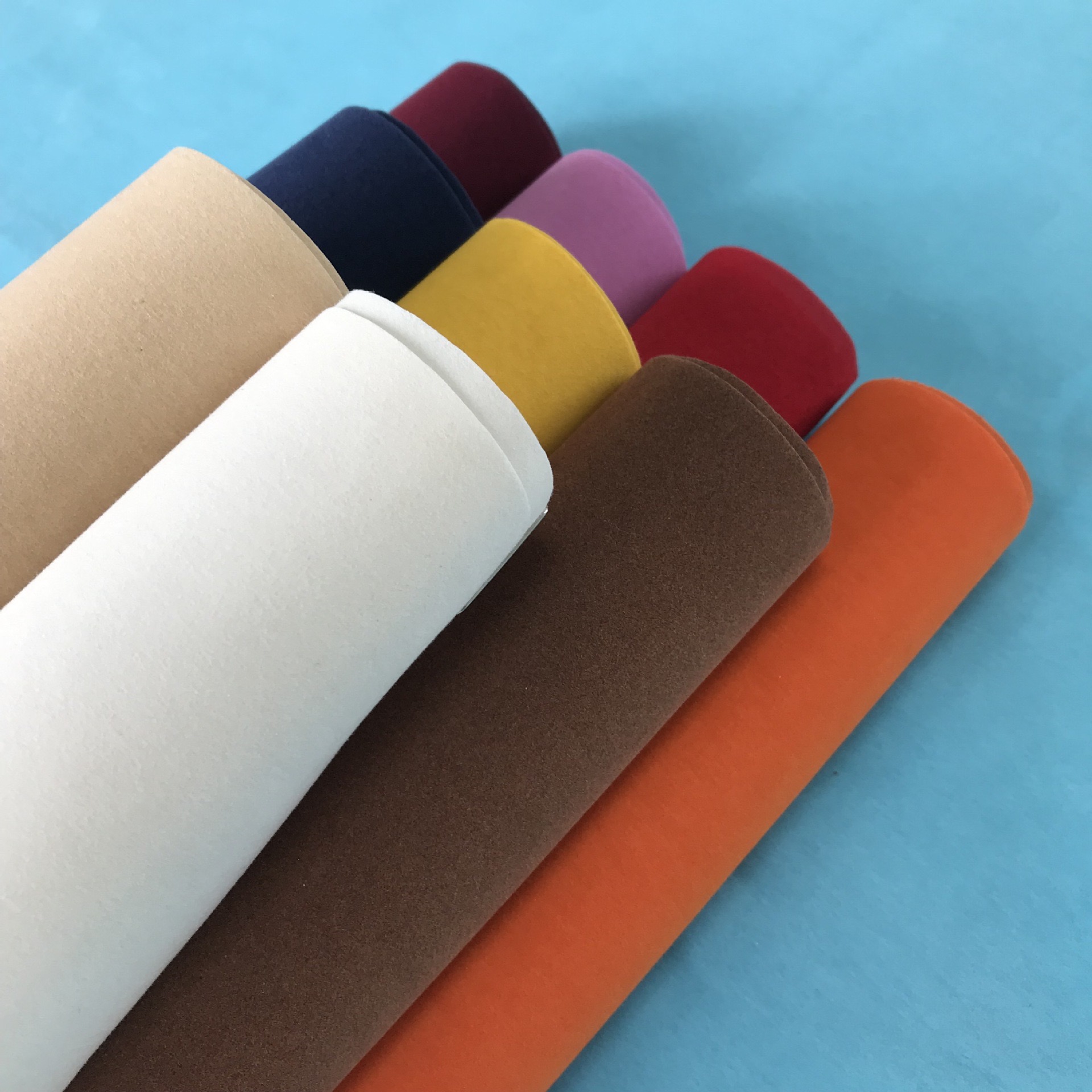
Adhesive chemistry plays an important role in preventing fiber loss. Standard solvent-based adhesives deteriorate when exposed to moisture or temperature fluctuations, leading to structural failures. Using eco-friendly, water-based acrylic systems that are solvent-free and contain no phthalate plasticizers or organotin anti-mold agents ensures long-term chemical stability. This is particularly relevant for jewelry box packaging, where volatile organic acids (such as formic and acetic acids) are controlled to prevent silver tarnish, maintaining an aqueous extract pH of 5.5 to 7.5. For example, in the long-term supply case with Chow Tai Fook, implementing these chemical restrictions alongside GRS-certified recycled fibers dropped the end-brand package failure rate to zero.
Mechanical stability is verified post-curing. The curing process in temperature-controlled ovens completely cures the adhesive matrix, removing residual moisture that might otherwise cause hydrolysis. The finished rolls must pass standard durability metrics, including a dry/wet color fastness rating of Grade 4 or above, a 10-cycle 3M tape peel test, and abrasion resistance testing up to 100,000 cycles for specialized functional products.
Data/Solution Comparison
| Pile Type / Series | Optimal Height Range | Adhesive Anchorage Type | 3M Tape Peel Test Result | Abrasion Resistance Cycle Limit | Target Application Industry |
|---|---|---|---|---|---|
| Short Pile (61 Series) | 0.3 – 0.5 mm | Water-based Acrylic | Pass (10 Cycles, No loss) | 500 Cycles (Standard) | Eyewear cases, jewelry box interiors |
| Medium Pile (31 Series) | 0.6 – 0.9 mm | Water-based Acrylic | Pass (10 Cycles, No loss) | 500 Cycles (Standard) | Gift box linings, drawstring pouches |
| Long Pile / Pearl Velvet | 1.0 – 1.2 mm | High-Density Water-based | Pass (10 Cycles, No loss) | 100,000 Cycles (Functional) | Luxury display trays, automotive interiors |
| Embossed / Frosted Velvet | Variable (0.3 – 1.2 mm) | Eco-friendly Acrylic | Pass (10 Cycles, No loss) | 500 Cycles (Standard) | Cosmetics, perfume packaging |
Frequently Asked Questions (FAQ)
Q1: Why does a pile height exceeding 1.2 millimeters increase the risk of shedding?
A1: Pile heights above 1.2 millimeters shift the fiber's center of gravity upward, increasing lateral leverage during physical contact. This mechanical stress can pull the fiber out of the adhesive layer unless the adhesive coating weight is increased, which in turn reduces fabric flexibility and compromises the soft hand feel.
Q2: How do environmental factors like humidity affect the pile adhesion of long pile velvet?
A2: Excessive humidity can cause moisture absorption in non-cured adhesives, weakening the bond. To prevent this, fabrics must undergo thorough heat-drying in temperature-controlled curing ovens. Controlling the moisture content ensures the polymer crosslinking remains stable, preventing humidity-induced shedding in enclosed packaging.
Q3: How does the choice of base fabric impact fiber retention?
A3: Spunlace and knitted base fabrics offer high flexibility and a uniform surface, allowing the adhesive layer to bond consistently. Nonwoven bases are highly cost-effective but have a less uniform fiber network, which requires strict in-process voltage and coating monitoring to maintain equivalent fiber anchorage.
Final Conclusion & Recommendations
For premium packaging requiring a rich tactile experience without shedding, specifying a pile height of 1.0 to 1.2 millimeters for long pile pearl velvet ensures the best balance of aesthetics and physical durability. Purchasing organizations should verify that materials are manufactured via high-voltage electrostatic systems and certified under ISO 9001:2015 and GRS standards. Under OEM/ODM business models, custom color orders starting at 1,000 yards are processed within a 14-day delivery cycle, while in-stock solutions with a 1-yard minimum order quantity are available for immediate prototyping. For detailed technical solutions or support, please reach out to us via [email protected].
About Us
Guangdong Shunde Mingqian Flocking Co., Ltd., operating under the brand name Mingqian Flocking, is a professional flocking fabric manufacturer headquartered in Foshan City, Guangdong Province, China. Established in 2008, the company operates a self-owned manufacturing facility covering over 12,000 square meters and houses more than 100 employees. The enterprise utilizes five automated electrostatic flocking production lines to achieve a monthly production capacity of 3,000,000 yards. The company holds ISO 9001:2015 Quality Management System certification and GRS 4.0 certification, serving major brand supply chains including Dior, Chow Tai Fook, and Volkswagen.

Lastest
-
How are rising fuel costs impacting global LCL shipping trends?
2026-08-02 -
Is it possible to emboss our brand logo on vegetan leather?
2026-08-02 -
How does the supplier handle defective parts of a K-House?
2026-08-02 -
How do I choose the right laser light show wattage for a 5000-person outdoor venue?
2026-08-02 -
How do I verify the actual brightness of an RGB laser projector before buying bulk?
2026-08-02
SUBSCRIBE
INQUIRY